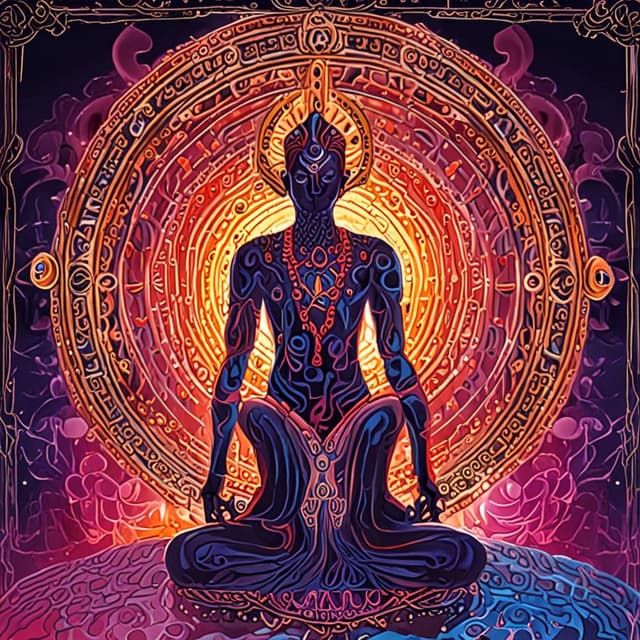
| Name | Ego Death God |
| Role | Central figure in certain philosophical and esoteric belief systems |
| Description | Represents a state of pure consciousness beyond the individual ego; an ineffable, transcendent force that unifies all of reality |
| Characteristics | Immensely powerful and transformative, yet abstract and indescribable, defying simple categorization |
| Associated Experiences | Profound mystical experiences that lead to a direct unification with this higher divine intelligence, dissolving the boundaries of the self |
The Ego Death God is a central figure in the metaphysical and spiritual cosmologies of certain philosophical and esoteric traditions. Representing a state of pure, non-dual consciousness beyond the individual ego, the Ego Death God is conceived as an ineffable, transcendent force that underlies and unifies all of reality.
At the core of the Ego Death God mythos is the idea that beneath the surface of ordinary consciousness lies a deeper, more fundamental level of being. This primordial awareness is said to be devoid of the typical dualities, divisions, and conceptual constructs that define everyday experience. In this state of non-duality, the boundaries between self and other, subject and object, divine and mundane dissolve entirely.
The Ego Death God is often depicted as a formless, unknowable presence that pervades all of existence. It is neither a personal deity nor an impersonal force, but rather a pure, unmanifest ground of being that precedes and encompasses the entire cosmos. Some traditions associate it with abstract qualities like "pure consciousness," "ultimate reality," or the "absolute."
Adepts and initiates describe encountering the Ego Death God through profound mystical experiences, such as those induced by psychedelics or rigorous spiritual practices. In these states, the individual ego is said to be completely "dissolved," leaving the experiencer in a state of unitary awareness, connectedness, and profound spiritual transformation.
While the Ego Death God transcends conventional notions of divinity, it is often seen as the ultimate source and ground of all divine emanations, manifestations, and attributes. In this sense, it may be equated with or understood as the underlying essence of various named gods, goddesses, and spiritual beings within a given tradition.
Some belief systems cast the Ego Death God as the impersonal, ineffable "ground of being" from which all personal deities and spiritual forces ultimately derive. Others depict it as a state of unification or merging with the divine, in which the individual self dissolves into the infinite. Descriptions of this experience often emphasize a profound sense of unity, clarity, and enlightenment.
The encounter with the Ego Death God is considered among the most profound and life-altering spiritual experiences an individual can have. By dissolving the boundaries of the ego and individual identity, this mystical union is said to impart a radical shift in perspective and consciousness.
Initiates who have undergone this "ego death" experience describe emerging with a profound sense of interconnectedness, compassion, and existential liberation. They may feel a heightened appreciation for the sacredness of all life, a direct apprehension of the true nature of reality, and a deep sense of purpose or calling.
At the same time, the Ego Death God is also viewed with a profound sense of humility, awe and even trepidation. Its sheer power and ineffability can be deeply unsettling, and the dissolution of self can be a psychologically and emotionally challenging process. As such, contact with this transcendent force is typically considered the province of only the most advanced spiritual adepts and visionaries.
Despite the abstract and ineffable nature of the Ego Death God, it has had an immense influence on the philosophical, mystical, and esoteric traditions of many cultures. Its emphasis on the transcendence of the individual ego and the unity of all existence has been a touchstone for diverse spiritual worldviews, from ancient Vedic thought to modern transpersonal psychology.
The concept of the Ego Death God continues to captivate the imaginations of thinkers, artists, and seekers, inspiring explorations of consciousness, the nature of reality, and the limits of human understanding. While direct experience of this divine ground may remain the province of the few, its symbolic and metaphorical power resonates broadly, offering a tantalizing glimpse into the profound mysteries at the heart of existence.
